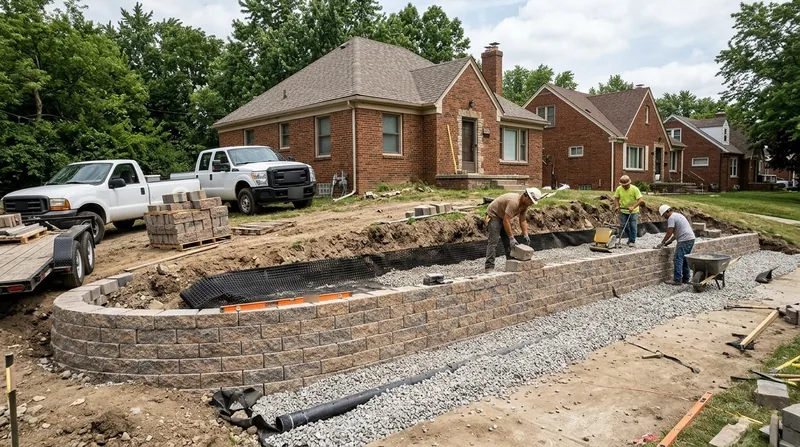




Retaining Wall Installation in Detroit requires deep understanding of the region's glacial clay soils, high water table, and freeze-thaw cycles that destabilize walls year after year. Detroit's architectural heritage, from Palmer Woods Tudors to Sherwood Forest Colonials to thousands of 1920s brick bungalows and 1950s ranches in the inner suburbs, sits on a flat lake plain where small grade changes demand smart wall design. Driveways need ramps, patios sink below grade, ravine-edge properties along the Rouge and Clinton Rivers need erosion control, and window wells need structural support. Our installation process begins with footings dug below the frost line, proper drainage gravel backfill, and material selection matched to your site and budget. We handle poured concrete, segmental block, Michigan fieldstone, glacial boulders, and timber construction. Call us at (313) 474-9126 for a free estimate, or learn more about our retaining wall repair services if an existing wall is failing.
Why Retaining Wall Installation Matters in Detroit's Heavy Clay and High Water Table
Detroit sits on dense, poorly drained glacial clay with a high water table, especially near the Detroit River and the Rouge. Spring storms saturate the soil, frost heave pushes walls upward in winter, and thaw cycles crack and shift them. A wall built without proper drainage and frost-line footings fails within five to ten years. New construction done right lasts decades and protects your property investment, your driveway, your patio, and the stability of ravine banks where homes sit close to water.
- We excavate footings below the local frost line (typically 42 to 48 inches in the Detroit area) to prevent frost heave from lifting or cracking the wall.
- We install gravel backfill and drainage systems behind the wall to move water away from the soil and reduce hydrostatic pressure.
- We compact and prepare the base properly so settlement does not occur and the wall stays level and plumb for decades.
- We design the wall height, slope, and material to match your site conditions, local codes, and aesthetic goals in neighborhoods from Dearborn to Grosse Pointe Woods.
A properly installed wall handles Detroit's climate and keeps your yard stable, dry, and usable.
Key info: Many Detroit jurisdictions require a permit for walls above 4 feet or walls that support a driveway or structure. Check with your local building department (thresholds vary by city). We handle permitting guidance and can coordinate with your municipal inspector throughout the project.
How We Install Retaining Walls in Detroit: Step-by-Step Process
Our installation workflow is methodical and site-specific. We begin with a thorough site visit to assess soil conditions, drainage patterns, frost depth, and proximity to utilities and structures. We then design the wall, obtain permits where required, and execute the build with precision. Each step accounts for Detroit's clay soils and seasonal water movement.
- We schedule a free site inspection and discuss your goals, budget, and material preferences.
- We prepare the site by marking the wall line, removing vegetation, and setting up equipment access and safety barriers.
- We excavate the footing trench to the required depth (below frost line) and compact the base with gravel.
- We build the wall using your chosen material (concrete, block, stone, or timber) and ensure it is level, plumb, and properly backfilled.
- We install drainage gravel and a perforated drain pipe behind the wall to manage water and prevent pressure buildup.
- We backfill, compact, and finish the site with topsoil and seed or plantings as desired.
The entire process respects Detroit's freeze-thaw cycle and ensures long-term stability.
Example: A homeowner in Royal Oak needed a 5-foot driveway ramp to a sunken garage. We installed a poured concrete wall with a frost-line footing, integrated drainage, and a battered face for visual appeal. The wall has held steady through three Michigan winters with zero movement. See our concrete retaining walls page for more details on this method.
Retaining Wall Installation Methods and Materials for Detroit Sites
Detroit homeowners have multiple options for retaining wall construction. Each material and method brings different durability, aesthetics, and cost profiles. We assess your soil, climate exposure, and budget to recommend the best fit for your property.
| Approach | Description | Best for |
|---|---|---|
| Poured Concrete | Monolithic concrete wall cast in place with reinforcing steel and a proper frost-line footing. Highly durable in freeze-thaw climates. | Driveway ramps, tall walls, high-load applications, long-term permanence. |
| Segmental Block (SRW) | Interlocking concrete or composite blocks stacked and backfilled with gravel. Flexible and easy to modify. Excellent drainage. | Medium-height walls, terraced gardens, landscaping features, moderate budgets. |
| Michigan Fieldstone or Glacial Boulder | Dry-stacked or mortared natural stone sourced locally. Blends into the landscape and ages beautifully. Requires skilled masonry. | Ravine edges, heritage properties, aesthetic focal points in Grosse Pointe or Bloomfield Hills. |
| Timber (Treated or Composite) | Pressure-treated lumber or composite boards installed with a proper base and backfill. Warm aesthetic but requires eventual replacement. | Lower walls, planter beds, temporary solutions, budget-conscious projects. |
Each method integrates drainage and frost protection to survive Detroit's climate. We recommend poured concrete or segmental block for most permanent installations because they handle clay saturation and freeze-thaw stress without degradation.
Retaining Wall Installation Cost in Detroit: What to Expect
Retaining wall installation costs in Detroit typically start at $30 per square foot and rise based on material, height, site access, soil conditions, and whether the wall requires an engineered design and permit. A 4-foot-tall, 20-foot-long concrete wall runs roughly $2,400 to $3,200 before permits and site prep. Segmental block costs slightly less per square foot but may require more labor. Natural stone and timber vary widely. Tall walls, tiered designs, and sites with poor access or complex drainage needs command higher estimates. We always recommend getting two or three quotes from licensed contractors to compare pricing and scope. Visit our pricing page for a detailed breakdown by material and wall size.
Cost factors: Wall height (taller walls cost more), material choice (concrete and stone higher than timber), site access (tight yards increase labor), soil prep (clay removal and gravel import add cost), drainage design (perforated pipe and gravel backfill are essential and add value), and permitting (some municipalities charge inspection and plan-review fees). Frost-line footing depth in Detroit averages 42 to 48 inches, which is reflected in our labor estimates.
Retaining Wall Installation Near Me: What to Look for When Hiring a Contractor in Detroit
Choosing the right contractor for your retaining wall installation is critical. A poorly built wall fails in a few years and costs far more to repair. Ask for proof of licensing and insurance, check references from recent projects in your neighborhood, and verify that the contractor understands Detroit's soil and climate challenges. Always confirm permit requirements with your local building department before signing a contract.
- Verify that the contractor holds a current Michigan contractor license and carries general liability and workers compensation insurance.
- Request references from at least three recent projects in Detroit or your suburb and call them to ask about the quality, timeline, and durability of the wall.
- Ask whether the contractor will obtain permits or guide you through the permitting process with your local city or township.
- Confirm that the contractor designs footings below the frost line and includes gravel backfill and drainage in the scope of work.
- Get a detailed written estimate that breaks down material, labor, site prep, and cleanup so you can compare apples to apples.
- Check the contractor's experience with your chosen material (concrete, block, stone, or timber) and ask to see photos of similar walls they have built.
A licensed, insured, and experienced contractor protects your investment and ensures your wall stands for decades. Contact us at detroit-retaining-wall.com/contact/ for a free, no-obligation estimate and references from our recent work in your area.
Retaining Wall Installation in Detroit: Pricing Guide
| Service | Price | Details |
|---|---|---|
| Poured Concrete Wall | Starting at $30/sq ft | Footings below frost line, reinforcing steel, drainage gravel, labor, and finish. Price rises with wall height and site complexity. |
| Segmental Block (SRW) Wall | Starting at $25/sq ft | Interlocking blocks, gravel backfill, base prep, and installation. Slightly lower than concrete due to faster assembly and flexible design. |
| Natural Stone or Boulder Wall | Starting at $35/sq ft | Michigan fieldstone or glacial boulder, sourced locally, mortared or dry-stacked, drainage, and skilled masonry labor included. |
| Timber Retaining Wall | Starting at $20/sq ft | Pressure-treated or composite lumber, base gravel, backfill, and installation. Lower cost but requires eventual replacement in 10 to 15 years. |
| Complex or Tiered Installation | On estimate | Engineered design, multiple wall sections, slope stabilization, or specialized drainage systems require site inspection and custom pricing. |
| Free Estimate and Site Visit | No charge | We visit your property, assess soil and drainage, discuss options, and provide a detailed written quote within 24 hours of inspection. |
Indicative pricing, the exact cost depends on square footage, finish, and site access. Free personalized estimate within 24h at (313) 474-9126.


