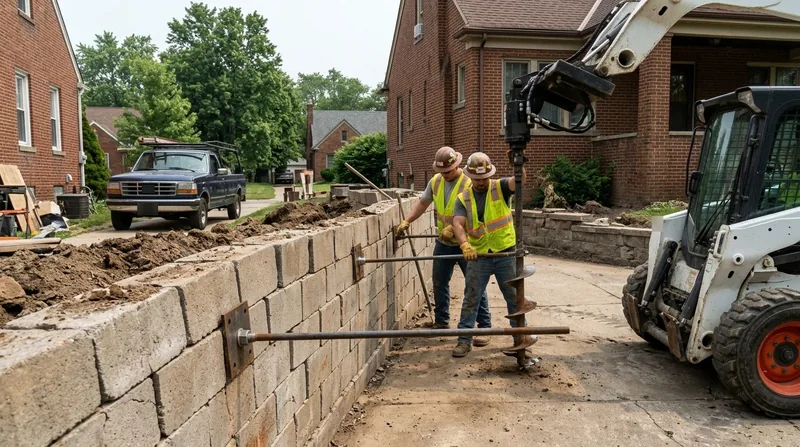




Retaining Wall Repair in Detroit stops the freeze-thaw damage and clay pressure that destabilize walls across Palmer Woods, Sherwood Forest, and the brick bungalow neighborhoods of the east and west sides. Detroit sits on a flat glacial lake plain of dense, poorly drained clay, where the water table runs high near the Detroit River and the Rouge. When spring storms saturate that clay, frost heave lifts and splits walls. When summer heat dries it out, the clay shrinks and leans inward. We catch these walls before they fail completely, using drainage repair, tieback anchors, and partial rebuilds to restore them to grade and function.
Why Retaining Wall Repair Matters in Detroit's Clay Landscape
Detroit's retaining walls hold driveway ramps, sunken patios, raised beds, window wells, and the ravine banks of the Rouge and Clinton rivers. Most are built in poured concrete, CMU block, segmental block, Michigan fieldstone, or aging landscape timbers. The problem is water. High groundwater, poor drainage, and the freeze-thaw cycle that runs from November through April crack and heave these walls faster than anywhere else in the region. A leaning wall is not cosmetic. It signals that soil pressure, water infiltration, or frost heave is at work, and that failure is coming. Early repair saves the wall, the property, and your foundation.
- We assess drainage first, because water behind the wall is the root cause of 80 percent of failures in Detroit's clay.
- We install French drains, perforated pipes, and gravel backfill to move water away from the wall face and footing.
- We install tieback anchors and geogrids to anchor the wall back into stable soil and resist outward bowing.
- We rebuild sections that are cracked, heaved, or leaning beyond the reach of anchoring alone.
- We verify setback and property-line compliance with the local building department before we start work.
Each repair method addresses a specific failure mode, and we choose based on site inspection and soil conditions.
Key info: A wall leaning more than one inch per foot of height, or showing stepped cracks in the mortar, needs professional assessment. In Dearborn, Livonia, and Royal Oak, we see this damage every spring after heavy snowmelt. Call (313) 474-9126 for a free on-site evaluation.
For more on how water destroys walls, see our page on Retaining Wall Drainage.
Verify your contractor's status at Michigan Secretary of State before signing a contract.
How We Repair Retaining Walls in Detroit: Step by Step
Repair starts with diagnosis. We dig or probe to expose the footing, check for water pooling, measure the lean, and photograph cracks. From there, we choose the repair method that addresses the root cause. Some walls need drainage only. Others need anchoring. A few need partial or full rebuilds. We work within your property lines and coordinate with your local building department on permit requirements.
- We visit your site and inspect the wall face, footing, and soil behind it for signs of water, frost heave, or settlement.
- We measure lean, map cracks, and test soil drainage to understand what is pushing the wall out of plumb.
- We recommend a repair method: drainage correction, tieback anchors, geogrids, or partial rebuild.
- We obtain any required permit from your city or township building department before starting excavation.
- We execute the repair, backfill, and compact soil to original grade, then test drainage and anchor tension.
- We photograph the finished work and provide a warranty on materials and labor.
The whole process, from estimate to final grade, typically takes one to three weeks depending on wall size and weather.
Local example: A 1920s brick bungalow in Detroit's Corktown neighborhood had a four-foot CMU wall holding back a driveway ramp. After two winters of freeze-thaw, it leaned six inches inward and cracked at the mortar joints. We installed a French drain at the footing, added two tieback anchors to the stable clay below, and reset the top course of block. The wall is now plumb and the driveway is safe. Total time on site: four days.
If your wall is severely damaged, see our page on Retaining Wall Replacement to understand when rebuild is the better choice.
Repair Methods and When to Use Each
| Approach | Description | Best for |
|---|---|---|
| French Drain and Backfill | We excavate behind the wall, lay perforated pipe, and backfill with gravel and landscape fabric to redirect groundwater away from the footing and wall face. | Walls with wet soil or standing water behind them, or those leaning slightly due to hydrostatic pressure. |
| Tieback Anchors and Geogrids | We drill or excavate to install steel cables or geogrids anchored into stable soil behind the wall, pulling it back to plumb and resisting outward bowing. | Walls leaning one to three inches per foot, or supporting a driveway or structure surcharge. |
| Partial Rebuild or Repointing | We remove and reset cracked or heaved sections of block, brick, or stone, repoint mortar joints, and compact the backfill behind them. | CMU, segmental block, or stone walls with localized damage, frost heave, or stepped cracks in mortar. |
| Helical Piles or Underpinning | We install deep anchors or piers beneath the footing to stabilize the wall if settlement or subsidence is the cause of lean or cracking. | Walls sinking into soft clay or settling unevenly, usually in combination with drainage repair. |
We assess your wall on site and recommend the most cost-effective method for your specific failure mode.
Retaining Wall Repair Cost in Detroit: What to Expect
Repair costs in Detroit range from $1,500 for simple drainage correction on a short wall to $8,000 or more for a large wall requiring anchors, partial rebuild, and engineered design. The biggest factors are wall height, length, material type, and how much excavation and backfill the job requires. A wall in Grosse Pointe Woods made of fieldstone and holding a ravine bank will cost more than a four-foot CMU wall in a residential yard. Access also matters. If we can bring equipment close, costs drop. If we hand-dig and hand-compact in a tight space, labor goes up.
Most homeowners spend $3,500 to $6,000 for a mid-sized wall repair including drainage, one or two tieback anchors, and partial rebuild of the top courses. We always get a free estimate, and we recommend getting two or three quotes so you can compare scope and price. Some contractors quote low and cut corners on drainage or anchor depth. We quote fair and do the work right the first time.
See our Pricing page for a detailed breakdown by repair type and wall size.
What to Look for When Hiring a Retaining Wall Contractor Near Me in Detroit
Choosing the right contractor matters because a failed repair wastes money and puts your property at risk. Look for a licensed and insured contractor with experience in Detroit's clay soil and freeze-thaw environment. Ask for references from similar jobs in your neighborhood. Check whether the contractor pulls permits and coordinates with your city or township building department. If your wall is tall, tiered, or supports a structure or driveway, the contractor should be able to source engineered drawings if required by your local code.
- Verify that your contractor holds an active Michigan construction license and carries general liability and workers compensation insurance.
- Ask for three references from homeowners in Detroit, Dearborn, or Livonia who had similar walls repaired in the past two years.
- Confirm that the contractor will obtain a permit from your city or township if the wall is above four feet or supports a surcharge.
- Request a written estimate that itemizes drainage work, anchors, materials, labor, and backfill separately so you know what you are paying for.
- Check whether the contractor offers a warranty on the repair, typically one to five years depending on the method.
- Ask whether the contractor is familiar with HOA rules or deed restrictions on your property that might affect the repair scope.
If you are ready to move forward, contact us for a free estimate. We respond within 24 hours and never charge for an on-site inspection or quote.
Retaining Wall Repair in Detroit: Pricing Guide
| Service | Price | Details |
|---|---|---|
| Drainage correction and gravel backfill | Starting at $1,500 | French drain, perforated pipe, and compacted backfill for walls with high groundwater or seepage damage |
| Tieback anchors and geogrids | Starting at $2,500 | Two to four anchors installed to resist outward bowing and lean in CMU, block, or stone walls up to six feet tall |
| Partial rebuild and repointing | Starting at $3,000 | Remove, reset, and repoint one to two courses of block or stone; includes new mortar, compacted backfill, and frost-resistant base preparation |
| Full wall rebuild or replacement | On estimate | Required when wall is more than 50 percent damaged, severely leaning, or collapsed; scope and material choice drive final cost |
| Travel and site visit | Included | No mileage charge or travel fee within Detroit and surrounding service areas; included in estimate and repair quote |
| Free estimate and design consultation | Free | On-site inspection, photos, drainage assessment, and written quote with no obligation; response within 24 hours at (313) 474-9126 |
Indicative pricing, the exact cost depends on square footage, finish, and site access. Free personalized estimate within 24h at (313) 474-9126.


