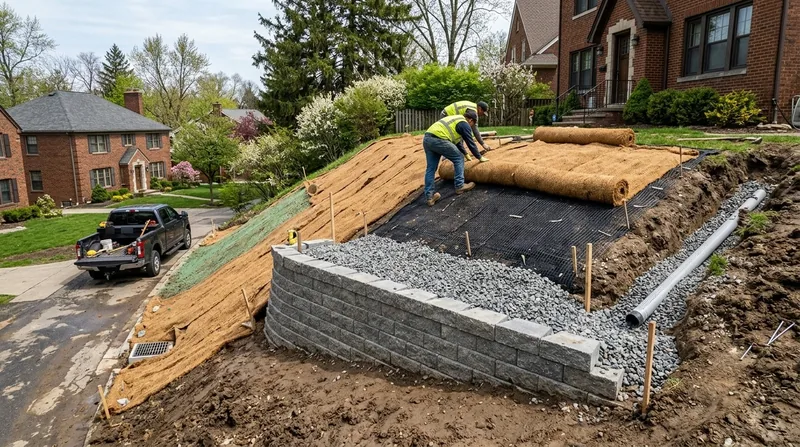




Slope Stabilization & Erosion Control in Detroit protects your home, driveway, and yard from the relentless push of water and freeze-thaw cycles that destabilize clay banks and ravine slopes across the region. Detroit sits on a flat glacial lake plain of dense, poorly drained clay, where the water table runs high near the Detroit River and the Rouge, making slope failure a constant threat after heavy spring rains and winter ice melt. Properties in Sherwood Forest, Palmer Woods, and along the Rouge River ravine face active erosion that undermines foundations, buckles driveways, and collapses aging timber walls built decades ago. We stabilize slopes and eroding banks with terraced retaining walls, geogrid reinforcement, and drainage systems designed to handle Detroit's punishing seasonal swings. Call us at (313) 474-9126 for a free estimate, or read on to understand how we protect your property year-round.
Why Slope Stabilization Matters in Detroit: Clay, Water, and Freeze-Thaw Failure
Detroit's glacial clay soils hold water like a sponge, and when spring thaw or heavy rain saturates the ground, that moisture puts enormous pressure on unprotected slopes. Freeze-thaw cycles crack and heave concrete, push timber walls off plumb, and loosen the mortar in aging CMU and fieldstone structures. The Rouge River and Clinton River ravine banks erode constantly, eating away at yards and threatening homes built on bluffs. Without proper slope stabilization, small grade changes become dangerous liability, and expensive damage spreads fast.
- Saturated clay after spring storms and snowmelt destabilizes unbraced slopes and erodes ravine banks at an accelerated rate.
- Frost heave and ice pressure push timber walls, segmental blocks, and poured concrete structures out of alignment each winter.
- Poorly drained yards develop standing water that weakens soil bearing capacity and triggers foundation settlement near the wall.
- Aging landscape timbers and deteriorated CMU walls fail suddenly under hydrostatic load and provide no warning before collapse.
- Ravine lots and river-bluff properties face active bank erosion that can advance several feet per season without intervention.
Addressing slope and bank erosion early prevents catastrophic failure and protects your property investment.
Key info: A home in Indian Village with a sunken patio backed by a failing timber wall saw water pooling under the foundation after heavy rain. We installed a terraced block wall with geogrid and a drainage system that eliminated the pooling and stabilized the slope permanently. The frost heave that had cracked the old timber stopped immediately.
For more detail on how water damages walls, see our guide to Retaining Wall Drainage in Detroit.
The Michigan Department of Environment, Great Lakes, and Energy (EGLE) provides guidance on erosion control and slope stabilization for homeowners; consult your local building department to verify permit thresholds for your jurisdiction.
How We Stabilize Slopes and Eroding Banks in Detroit
Slope stabilization in Detroit begins with a site visit to assess soil type, water flow, and the extent of erosion or wall failure. We design a system that redirects water away from the slope, reinforces the soil with geogrid or soil nails, and builds a tiered wall structure that distributes load safely. The process accounts for frost heave, seasonal water table rise, and the specific clay composition of your lot. Most jobs combine a new retaining wall, subsurface drainage, and grading to restore slope stability and protect your home for decades.
- We excavate the slope to stable grade, remove failed or undermined wall material, and expose the clay to proper depth.
- We install a drainage layer (perforated pipe, gravel, and geotextile) behind the new wall to intercept groundwater and direct it away.
- We place geogrid reinforcement between wall courses or in the retained soil to increase shear strength and prevent sliding.
- We build the new wall in concrete, segmental block, or stone, set on a proper footing below the frost line (typically 42 to 48 inches in Detroit).
- We grade and shape the slope above the wall to promote surface drainage and prevent ponding that feeds back into the retained soil.
The result is a stable, drained slope that sheds water, resists frost heave, and protects your foundation and yard for years to come.
Local example: A property in Dearborn Heights had a leaning block wall holding back a driveway ramp. The wall had moved nearly 3 inches in five years due to hydrostatic pressure and poor drainage. We removed the old wall, installed 4 feet of new reinforced segmental block with geogrid and a full drainage system, and reset the driveway on a proper gravel base. The slope has been stable for three years with no movement.
Learn more about our Block & Segmental Retaining Walls and how they perform in Detroit's climate.
Slope Stabilization Methods: Choosing the Right Approach for Your Site
Different slopes and erosion problems call for different solutions. A ravine bank eroding into a neighbor's yard requires aggressive geotextile and live planting. A driveway ramp that's settling needs a reinforced wall with proper footing and drainage. A sunken patio surrounded by standing water needs a perimeter wall with subsurface drainage and grading. We assess your specific failure mode, soil type, and site conditions to recommend the most durable and cost-effective method.
| Approach | Description | Best for |
|---|---|---|
| Terraced Block Wall with Geogrid | Segmental retaining wall reinforced with geogrid layers between courses, built on a proper footing with subsurface drainage behind. | Moderate to steep slopes, driveway ramps, raised patios, and slopes up to 15 feet tall that need long-term stability in clay soils. |
| Poured Concrete Wall with Weep Holes | Engineered concrete stem wall cast on a footing, with integrated drainage and weep holes every 6 feet to release hydrostatic pressure. | High-load situations, basement window wells, and slopes adjacent to foundations where a monolithic, durable structure is essential. |
| Boulder and Natural Stone Wall with Geotextile | Stacked glacial boulders or fieldstone, graded and set in a running bond, with geotextile behind to filter water and prevent soil loss. | Ravine banks, river bluffs, and aesthetic applications where natural appearance is priority and slopes are moderate or low-load. |
| Soil Nail Wall with Shotcrete | Steel nails driven into existing slope, connected with a facing of shotcrete and drainage, to anchor unstable soil in place without major excavation. | Existing slopes with limited space, ravine sides where removal is infeasible, and temporary stabilization ahead of permanent wall construction. |
| Vegetated Slope with Erosion Control Blanket | Native plantings, erosion control blanket, and subsurface drainage combined to stabilize gentle slopes and reduce runoff velocity over time. | Low-grade slopes, ravine restoration, and environmental sites where living systems and habitat are as important as structural stability. |
Slope Stabilization & Erosion Control Cost in Detroit: What to Expect
The cost of slope stabilization and erosion control in Detroit depends on the wall height, slope length, soil conditions, drainage complexity, and whether you need engineered plans. A simple terraced block wall for a driveway ramp runs lower than a deep ravine stabilization with multiple tiers and extensive grading. Access, site debris removal, and whether we're replacing a failed wall or building on virgin slope all factor into the final price. We start every job with a free site estimate so you know the exact scope and cost before we begin work.
Factors that move the price up include:
- Wall height and total linear footage of the retaining structure needed to stabilize the entire slope.
- Soil type and stability, including whether we encounter rock, poor drainage, or high water table conditions.
- Drainage system complexity, including perforated pipe, gravel layers, and distance to daylight or storm drainage.
- Geogrid reinforcement and engineering drawings, required for walls over 4 feet in most jurisdictions or when supporting a structure.
- Site access and debris disposal, including whether we can stage equipment safely and where excavated material goes.
Most homeowners in Detroit get 2 to 3 estimates before committing, and we recommend that approach. It ensures you understand the scope, compare methods, and feel confident in your contractor's plan. Call us at (313) 474-9126 for your free estimate, and visit our Pricing page for typical costs across different wall types and sizes.
Slope Stabilization & Erosion Control Near Me: What Detroit Homeowners Should Know When Hiring
Choosing the right contractor for slope stabilization is critical, because a poorly designed or installed wall fails fast in Detroit's climate. Look for a company that is licensed and insured, understands local soil and frost conditions, and can walk you through permits and engineering requirements. Many jurisdictions require a permit for walls above roughly 4 feet measured from the footing, or when a wall supports a surcharge such as a driveway or structure. Engineered drawings may be required for tall or tiered walls. Always verify setback and property-line rules with your local building department before design begins, as thresholds vary by city.
- Confirm your contractor holds a current Michigan Residential Builder license and carries general liability and workers compensation insurance.
- Request references from recent slope stabilization or retaining wall jobs in your neighborhood or similar soil conditions.
- Ask whether the contractor handles permitting and will coordinate with your local building department, or whether you need to pull the permit yourself.
- Verify that the contractor understands Detroit's freeze-thaw cycles, clay soils, and high water table, and has experience with multi-tier walls and drainage systems.
- Get the estimate in writing with a detailed scope, material list, timeline, and warranty covering structural performance and drainage function.
Contact us today for a free estimate and a detailed plan tailored to your slope, soil, and site conditions.
Slope Stabilization & Erosion Control in Detroit: Pricing Guide
| Service | Price | Details |
|---|---|---|
| Free Estimate | Free | On-site inspection, slope assessment, and written estimate within 24 hours, no obligation to hire |
| Terraced Block Wall with Drainage | Starting at $8,500 | Segmental retaining wall with geogrid, subsurface drainage, and grading, typical for driveway ramps and moderate slopes up to 8 feet |
| Poured Concrete Wall | Starting at $11,200 | Engineered concrete stem wall on footing with weep holes and drainage, for high-load situations and window wells |
| Ravine Bank or Multi-Tier Stabilization | On estimate | Complex slope work requiring geotextile, multiple walls, extensive grading, and engineering; site visit and design needed for accurate pricing |
| Engineering and Permit Drawings | Included or $1,200-$2,500 | For walls over 4 feet or supporting structures; included in estimate or charged separately depending on complexity |
| Travel and Mobilization | Included | No separate mileage fee or travel charge in Detroit and surrounding service areas |
Indicative pricing, the exact cost depends on square footage, finish, and site access. Free personalized estimate within 24h at (313) 474-9126.


